






About the Client
The Ministry of Industry and Commerce (MoIC) of Lao People’s Democratic Republic is the national authority responsible for business registration and regulatory services. Its mandate includes overseeing enterprise registration, maintaining business records, and supporting the development of a transparent and efficient business environment.
The system was developed as part of the World Bank–financed Lao PDR Competitiveness and Trade Project (LCTP), which supports reforms aimed at improving the business environment and facilitating private sector development.
The initiative involved close collaboration between the Ministry, the National Implementation Unit (NIU), and local IT partners providing in-country technical support.
The system supports business registration services across the country, providing a centralized digital environment for managing registration processes and business data more efficiently.
Challenge
Prior to the project, business registration processes in Lao PDR were largely paper-based and fragmented across institutions. This resulted in slow service delivery, limited transparency, and administrative burdens for both businesses and government staff.
Manual workflows required in-person visits, repetitive data entry, and physical document handling, increasing the risk of errors and delays. Businesses – especially those outside major cities – faced additional barriers in accessing services.
The transition to a digital system required overcoming several structural challenges:
- Adapting the system to the Lao language and regulatory environment
- Establishing infrastructure within a government cloud framework
- Replacing fragmented manual processes with standardized digital workflows
- Addressing communication barriers and limited digital readiness
Following the successful implementation of the system, a new challenge emerged: ensuring its long-term operation. As a national, mission-critical platform, the system required continuous monitoring, timely issue resolution, and ongoing improvements to maintain performance and reliability.
Solution and Benefits
To address these challenges, NRD Companies designed and implemented the Electronic Business Registration System (eBRS) – a centralized digital platform that transformed how business registration services are delivered in Lao PDR.
The system replaced fragmented, paper-based workflows with standardized digital processes and was designed to enable business registration, amendments, and management of business data online. It also introduced greater transparency through centralized data access and improved service efficiency by reducing manual steps and processing times for business registration, licensing, amendments, and document verification services.
Key benefits include:
- Faster and more efficient business registration and licensing services through digital workflows and automated processing;
- Improved transparency through centralized digital services and digital verification;
- Reduced administrative burden for businesses and government staff by eliminating repetitive manual tasks and paper handling;
- Flexibility for future expansion and integration with additional government systems and digital services.
NRD Companies’ Products Implemented and Services Provided
The solution was built using the Unified Registration Platform (URP©) – NRD Companies’ low-code platform for developing secure and scalable government registry systems.
NRD Companies delivered the project end-to-end, covering both implementation and long-term support.
Implementation services included:
- System design, development, and deployment
- Integration with national systems (tax, e-payments)
- Migration of over 110,000 business records
- Documentation, training, and knowledge transfer
This structured approach ensures that the system remains stable, secure, and continuously evolving over time.
Results
The implementation of the eBRS represents a major step forward in the digital transformation of public services in Lao PDR.
The system has modernized how business registration services are delivered by replacing paper-based procedures with streamlined digital workflows. It provides the functionality for applications, company information updates, and registration-related services to be managed through a centralized digital environment, improving the efficiency of registration processes.
The platform also strengthens institutional capacity by centralizing business data, improving coordination between government entities, and supporting more consistent regulatory processes nationwide.
Key expected results include:
- Faster Service Delivery: Digital workflows reduce processing times for business registration, amendments, approvals, and document verification while reducing manual handling of documents.
- Increased Accessibility: The system provides the foundation for business registration services to be accessed online, supporting more convenient and accessible service delivery.
- Improved Transparency: Centralized data management and digital verification increase trust, improve traceability, and reduce opportunities for errors or manipulation.
- Higher Processing Capacity: Following go-live, the system is capable of handling up to 200 business registration submissions per day, supporting growing demand for digital services.
- Better Data Quality: Standardized digital processes improve the accuracy, consistency, and reliability of business records and reduce duplicate or incomplete information.
- Improved User Experience: The system is designed to support a simpler and more user-friendly registration process, with clearer procedures and reduced administrative complexity.
- Enhanced Interinstitutional Cooperation: Integration with tax and e-payment systems improves coordination between institutions and supports more efficient public service delivery.
- Long-Term Sustainability: The structured support and maintenance model ensures continuous system availability, stable performance, faster issue resolution, and ongoing scalability improvements.
- Strengthened Local Capacity: Knowledge transfer, training, and collaboration with local IT partners help build national expertise for long-term system management and future development.
Replicability
The eBRS implementation in Lao PDR demonstrates a scalable and adaptable model for digital government transformation.
By combining a robust platform (URP©), process re-engineering, and a structured support model, the solution can be replicated in other countries facing similar challenges in business registration.
The approach is particularly relevant for:
- Government registries such as tax, licensing, and land systems
- Countries transitioning from paper-based to digital administration
- Public sector systems requiring long-term operational sustainability
The hybrid support model – combining local and international expertise – ensures both immediate effectiveness and long-term resilience.
SDGs Addressed
The project contributes to several United Nations Sustainable Development Goals (SDGs) by supporting digital transformation, improving public sector efficiency, and creating a more business-friendly environment in Lao PDR.
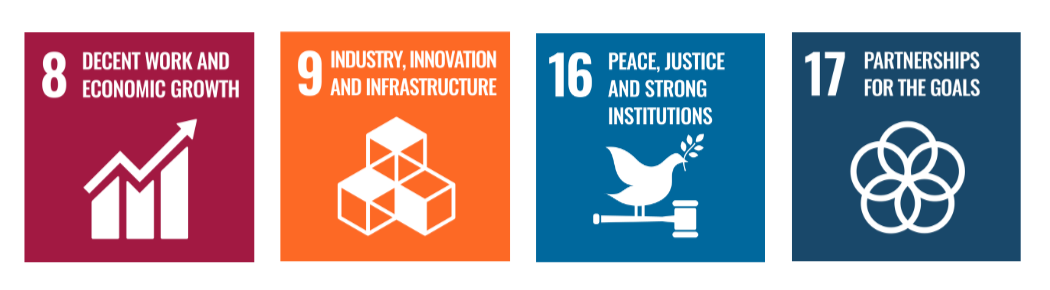
SDG 8: Decent Work and Economic Growth
The implementation of the eBRS simplifies and accelerates business registration procedures, reducing administrative barriers for entrepreneurs and companies. By making it easier to establish and manage businesses, the system encourages entrepreneurship, supports private sector growth, and contributes to a more competitive investment climate. Faster and more accessible registration services also help small and medium-sized enterprises (SMEs) participate more actively in the formal economy, supporting sustainable economic growth and job creation.
SDG 9: Industry, Innovation, and Infrastructure
The project strengthens national digital infrastructure by introducing a modern, secure, and scalable electronic business registration platform. Through the implementation of centralized digital services, integration with national systems such as tax and e-payments, and the adoption of standardized digital workflows, the initiative promotes innovation in public administration and supports the country’s broader digital transformation agenda. The system also creates a foundation for future expansion of e-government services.
SDG 16: Peace, Justice, and Strong Institutions
The eBRS enhances transparency, accountability, and efficiency within public administration. Centralized data management and digital verification improve the reliability and consistency of business records while reducing opportunities for errors, duplication, and manipulation. Standardized digital processes strengthen institutional governance and support more transparent interactions between businesses and government authorities. The project also contributes to building stronger institutions through knowledge transfer, local capacity development, and sustainable long-term system management.
SDG 17: Partnerships for the Goals
The project demonstrates the importance of international cooperation and multi-stakeholder collaboration in advancing digital government initiatives. The implementation was carried out through close cooperation between the Ministry of Industry and Commerce, the National Implementation Unit, local IT partners, NRD Companies, and the World Bank under the Lao PDR Competitiveness and Trade Project (LCTP). This collaborative approach combined international expertise with local capacity building to ensure sustainable implementation and long-term impact.