





About the Client
The Zimbabwe Revenue Authority (ZIMRA) is the governmental body entrusted with the critical task of collecting taxes and other revenue streams for Zimbabwe. Established under the Revenue Authority Act of 2002, ZIMRA’s mandate is comprehensive, encompassing revenue collection, trade, and travel facilitation, providing fiscal and economic advice to the government, and protecting civil society. ZIMRA is committed to becoming a beacon of excellence in fiscal services and facilitating trade and travel, which are crucial to Zimbabwe’s economic development.
Challenges
In alignment with its vision to mobilize revenue and foster sustainable compliance with fiscal laws, ZIMRA has been proactively involved in initiatives aimed at improving domestic taxation. One such initiative focused on sales data registration by retail traders and other businesses through fiscal devices and sales data controllers. However, several challenges emerged over time, highlighting the need for a new solution:
- Underutilized Data: Although data from fiscal devices was being collected, ZIMRA lacked the means to effectively utilize this data. This limitation hindered their ability to assess the quality of submissions and use the data for risk assessment and audit planning.
- High Costs of Fiscal Devices: The high acquisition costs of fiscal devices led to low adoption rates among taxpayers, thus impeding voluntary compliance initiatives.
- System Limitations: The existing system had reached its operational limits and was no longer capable of contributing significantly to ZIMRA’s vision or effectively reducing the Value Added Tax (VAT) gap in Zimbabwe.
Solution
To address these challenges, ZIMRA introduced the Fiscalisation Data Management System (FDMS) based on NRD Companies’ Virtual Fiscal Device Management System (VFDMS©), a comprehensive digital solution designed to enhance tax collection, enforce compliance, and encourage voluntary compliance. The FDMS is an integrated fiscalisation back-end solution that interfaces seamlessly with most of the existing and installed hardware fiscal devices at taxpayers’ points of sale. Additionally, the system introduces virtual fiscalisation solutions, capitalizing on digitalization opportunities.
The FDMS offers several key components:
- Central Platform: Facilitates the registration of taxpayers’ invoicing and Point of Sale (POS) solutions, managing the information collected by FDMS. This platform is essential for ZIMRA officers in their daily operations.
- FDMS API Gateway: Integrates taxpayers’ systems for submitting invoices, credit/debit notes, and other relevant data, ensuring the validation and consistency of the submitted information.
- Data Warehouse: Stores the collected information and provides data for ZIMRA’s risk and audit tools, enabling comprehensive analysis and oversight.
- Verification Portal: Allows buyers and auditors to verify the registration, validity, and consistency of invoices and submit complaints to ZIMRA if discrepancies are found.
- Self-Service Portal: Empowers vendors and suppliers of fiscal solutions to manage their invoicing information, review submitted invoices, and address errors identified by the system.
NRD Companies’ Solutions and Services
NRD Companies played a pivotal role in the successful implementation of FDMS by deploying and adapting its Virtual Fiscal Device Management System (VFDMS©) platform to meet the specific needs of Zimbabwe’s legislative and regulatory environment. The solution provided by NRD Companies includes all necessary FDMS components, along with additional functionalities such as invoice information reconciliation with the Automated System for Customs Data (ASYCUDA) and seamless integration with the new Tax and Revenue Management System (TaRMS), ZIMRA’s integrated Domestic Tax Management System. Additionally, the solution introduces inventory (stock) control layer, which provides ZIMRA with insights on the stock levels and stock movements of the taxpayers, and thus helps to prevent VAT fraud.
NRD Companies also contributed by:
- Provided complimentary Point-of-Sale solutions for Android and Windows environments, helping ZIMRA reach cost-sensitive taxpayer groups.
- Ensured the solution supports additional tax types and adapting swiftly to new currency requirements.
- Offered technical consultations to major taxpayers regarding system integration scenarios and providing advice on the best integration options.
Results
The implementation of the FDMS has already delivered measurable improvements in taxpayer compliance, revenue collection, and operational efficiency, confirming the effectiveness of Continuous Transaction Controls in reducing tax fraud and strengthening VAT administration.
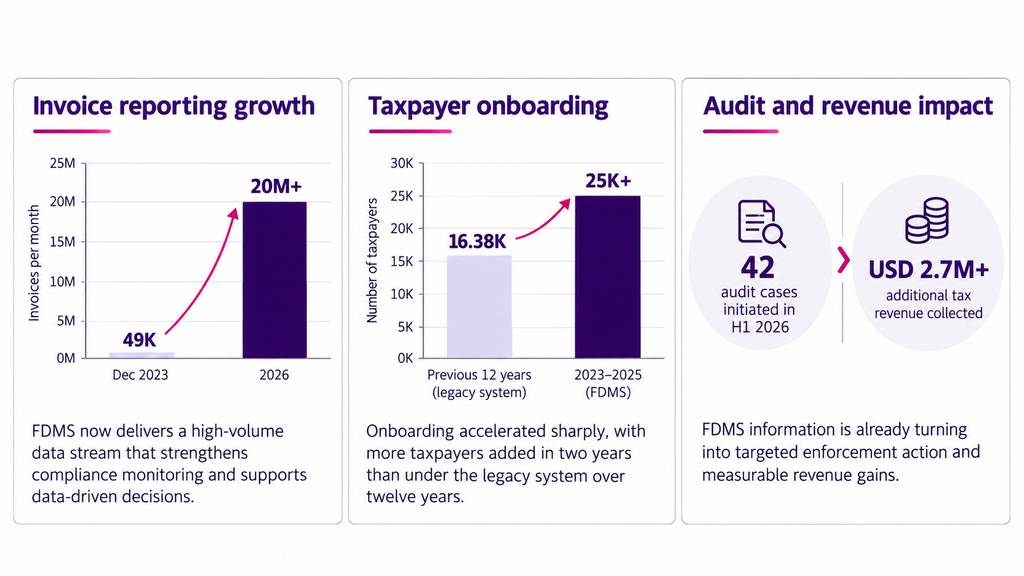
- Significant Growth in Invoice Reporting: The number of invoices transmitted to ZIMRA increased dramatically – from 49 thousand in December 2023 to over 20 million invoices per month in 2026, demonstrating rapid adoption of the system and establishing a strong data foundation for compliance control and AI-driven decision-making.
- Improved VAT Revenue Collection and Compliance: Analysis of 10,000 taxpayers shows that declared VAT in foreign currency increased from approximately USD 20 million in December 2023 to over USD 50 million by December 2024, indicating stronger compliance and reduced underreporting.
- Accelerated Taxpayer Onboarding: In just two years, ZIMRA registered more than 25K taxpayers in the FDMS – compared with 16.38K taxpayers registered over the previous 12 years under the legacy system, demonstrating a significant acceleration in taxpayer onboarding.
- Audit and Revenue Impact: In H1 2026 alone, ZIMRA initiated 42 audit cases based on information from the FDMS, resulting in more than USD 2.7 million in additional tax revenue collected.
- Early Compliance Impact: Even during initial rollout phases, the system contributed to a 5% increase in tax compliance within the first three months, highlighting the immediate value of adopting a proven digital fiscalisation solution.
- Operational Efficiency Gains: Automation and digitalisation significantly reduced administrative workload, with staff involved in fiscalisation decreasing from 120 to 45 employees, allowing resources to be reallocated to higher-value compliance and audit activities.
Impact on ZIMRA Operations:
- Enhanced Data Quality: Real-time validations and automated checks ensure accurate and reliable data for compliance and audit purposes.
- Reduced Fraud Opportunities: Continuous monitoring, invoice validation, and system integrations minimize manipulation and fraudulent reporting.
- Real-Time Compliance Monitoring: “Liveness” monitoring of POS systems enables faster identification of non-compliant taxpayers.
- Improved System Security: Secure data transmission and authentication mechanisms ensure data integrity.
- Comprehensive Data Oversight: ZIMRA now has full visibility of taxpayer activities, enabling better decision-making and enforcement.
- Faster Access to Insights: Real-time data supports improved forecasting and VAT revenue planning.
- Better Issue Prioritization: Automated categorization of invoice and POS issues enables more efficient operational response.
Impact on Taxpayers:
- Improved Service Delivery: Self-service portals reduce administrative burden and improve accessibility.
- Invoice Verification: Real-time verification via QR codes and authentication codes enhances trust and transparency.
- Increased Efficiency: Faster VAT refund processing and input tax verification.
- Lower Compliance Costs: Virtual fiscalisation reduces reliance on expensive hardware solutions.
- Greater Transparency: Taxpayers can validate invoices before claiming input tax, reducing disputes.
Replicability
The Fiscalisation Data Management System (FDMS) implemented by ZIMRA is based on VFDMS© by NRD Companies – a scalable and adaptable solution that can be replicated in other regions facing similar challenges in tax compliance and data management. Its modular design allows for easy customization to fit different legislative and economic contexts, making it suitable for diverse fiscal environments. The system’s proven flexibility, ease of implementation, and potential for integration with existing tax management platforms make it a viable option for countries seeking to enhance their tax administration without major disruptions. The success of FDMS in Zimbabwe serves as a model for other nations aiming to improve revenue collection and reduce tax fraud.
SDGs Addressed

SDG 8: Decent Work and Economic Growth
FDMS plays a crucial role in fostering sustainable economic growth by improving tax collection and compliance. By reducing the VAT tax gap and increasing revenue collection efficiency, the system ensures that the government has more resources to invest in public services and infrastructure. This, in turn, creates a more conducive environment for economic growth and job creation. Furthermore, by reducing the cost of compliance through virtual fiscalisation solutions, the FDMS supports small and medium-sized enterprises (SMEs), enabling them to thrive and contribute to the economy.
SDG 9: Industry, Innovation, and Infrastructure
The FDMS introduces innovative solutions that modernize Zimbabwe’s tax administration infrastructure. The system’s virtual fiscalisation component is a prime example of how technology can be leveraged to streamline processes, reduce costs, and increase compliance. This innovation not only enhances the efficiency of tax administration but also promotes the growth of the ICT sector in Zimbabwe. By providing compliant sales and invoicing solutions at no cost, especially to cost-sensitive taxpayers, the FDMS supports the development of a robust digital infrastructure, which is critical for sustainable industrialization.
SDG 12: Responsible Consumption and Production
The FDMS contributes to responsible consumption and production by enforcing transparency in transactions. The verification portals and continuous monitoring help ensure that businesses report their sales accurately, reducing the likelihood of underreporting and promoting fair trade practices. This transparency supports responsible business operations and sustainable production practices.
SDG 16: Peace, Justice, and Strong Institutions
FDMS significantly contributes to SDG 16 by strengthening the transparency and accountability of tax administration in Zimbabwe. By improving data quality, reducing opportunities for tax fraud, and enhancing the efficiency of audit and verification processes, the system helps build stronger institutions. The availability of accurate and timely fiscal data allows ZIMRA to make informed decisions, enforce laws fairly, and maintain public trust in the tax system. Moreover, the self-service portal empowers taxpayers by providing them with tools to manage their compliance, further enhancing transparency and reducing the potential for disputes.
SDG 17: Partnerships for the Goals
The development and implementation of FDMS highlight the importance of partnerships in achieving sustainable development. The collaboration between ZIMRA and NRD Companies demonstrates how public-private partnerships can lead to the successful implementation of complex systems that address national challenges. This partnership model can be replicated in other countries, fostering international cooperation, and sharing best practices in tax administration.