






Listen to the audio version of this article below.
The OECD’s latest Digital Government Index, published in February 2026, offers a useful reality check. Even among the most advanced governments, digital transformation remains uneven and, in some areas, incomplete.
Across OECD countries, the average Digital Government Index (DGI) score reached 0.70 in 2025, up from 0.61 in 2023 – a 14% increase. This is meaningful progress. But it also shows that governments are still far from full digital maturity.
For countries still building their digital foundations, this matters. The assumption that more advanced governments have already solved these challenges simply does not hold. In practice, many are facing the same issues – just at a different level of maturity.
High Rankings Do Not Mean Balanced Performance
What becomes clear very quickly is that progress is not balanced. Countries that rank highly overall still show weaker results in specific areas.
Korea, Australia, and Portugal lead the index, alongside countries like the United Kingdom, Denmark, and Estonia. Yet even these top performers do not perform equally across all six dimensions of digital government – digital by design, data-driven public sector, government as a platform, open by default, user-driven, and proactiveness.
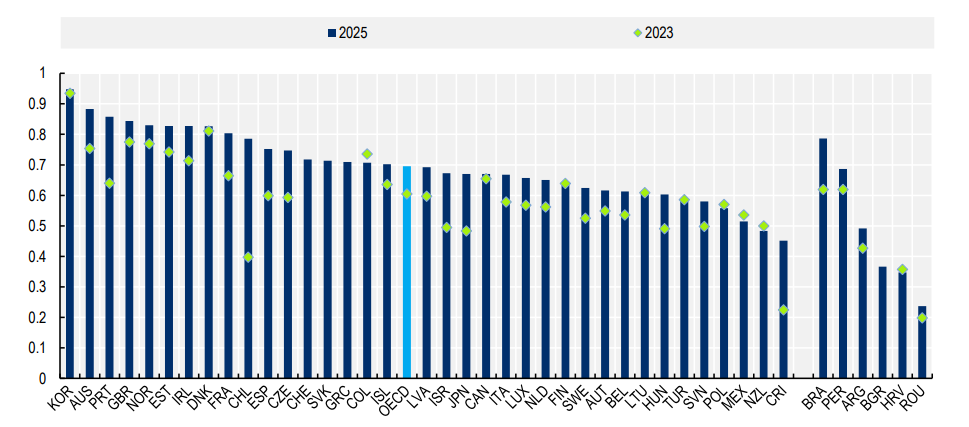
In particular, proactive service delivery and systematic use of data remain weaker areas across the board. Even the most advanced governments are not yet consistently anticipating user needs or fully using data to drive decisions.
Strategy Is No Longer the Differentiator
Another point the data makes quite clearly is that having a strategy is no longer what differentiates anyone.
Practically all countries assessed now have digital government strategies, frameworks, and policy commitments in place. Yet performance still varies significantly.
Countries such as Denmark stand out not because they have stronger strategies on paper, but because they apply them more consistently across institutions. Others show a more familiar pattern – strong central initiatives coexisting with uneven implementation across ministries.
From Foundations to Consistency
This internal imbalance is not limited to lower-performing countries. Even relatively well-performing countries, such as Lithuania, demonstrate that while the foundations are in place and progress is steady, consistency across institutions remains a challenge.
This reflects a broader pattern across the OECD: building digital capabilities is one step – applying them uniformly across government is another.
The Implementation Gap in Practice
The OECD results consistently point to the same issue: the gap between availability and actual use.
Data Governed, But Not Fully Used
Most governments now have data governance frameworks, standards, and policies. On paper, the architecture is there. But the findings show that data is still not systematically used in decision-making, and data sharing across institutions remains limited. This means governments are collecting and storing large amounts of data – but not yet consistently using it to improve services or shape policy.
Infrastructure Built, But Not Reused
Many countries have invested heavily in interoperability frameworks and shared digital components. Yet across the OECD, reuse of these shared solutions is far from systematic. Institutions continue to develop parallel systems instead of using what already exists. The infrastructure is there – but adoption is uneven.
Services Designed, But Not Consistent
User-driven design is more established, with countries like the United Kingdom and Canada making progress in measuring user satisfaction and integrating user needs. Still, these practices are not applied uniformly across government. Within the same country, the quality of services can vary significantly depending on the institution.
Proactive Services – Still Limited
The weakest area across the board remains proactive service delivery. While some countries are experimenting with more automated and anticipatory services, overall progress is limited. The OECD points to legal, technical, and organisational barriers – suggesting the issue is not intent, but the ability to align systems, rules, and institutions.
From Strategy to Practice – Where the Real Work Begins
Across OECD countries, three challenges stand out clearly:
- Solutions already exist, but are not consistently used across government.
- Data is governed, but not yet systematically applied.
- Implementation continues to vary across institutions.
At the same time, the report highlights what enables progress: strong governance and coordination, clear roles and responsibilities, and systematic monitoring of implementation.
Taken together, the message is straightforward. The building blocks of digital government are now widely in place. Strategies exist. Infrastructure exists. Policies exist. But putting all of this into consistent, system-wide practice remains a work in progress. For countries still developing their digital government systems, this is perhaps the most relevant takeaway. The challenge is no longer only what to build – but how to ensure that what is built is actually used, reused, and applied across government. This is where the gap between progress on paper and progress in practice becomes most visible.
At NRD Companies, this is where the focus lies. NRD Companies supports governments in designing digital government frameworks that work in practice – across institutions, systems, and sectors. This includes:
- strengthening interoperability and data exchange to enable real use of data.
- supporting the implementation of shared platforms and registries.
- helping governments move from isolated solutions to integrated ecosystems.
- ensuring that policies translate into operational, scalable systems.
- facilitating change management to align institutions, build ownership, and embed digital transformation in everyday government practice.
In practice, the challenge is rarely the absence of solutions. It is ensuring that those solutions are adopted, connected, and consistently used across government.


Working on digital government transformation and facing similar challenges?
Get in touch.



Thank you for your message!
Our team will review it and get back to you shortly. For urgent questions, you can reach us at connect@nrdcompanies.com