






About the Client
The Customs Department under the Ministry of Finance of the Republic of Lithuania is the national authority responsible for implementing customs policy, collecting customs duties and taxes, facilitating legitimate international trade, and protecting the economic interests, security, and safety of Lithuania and the European Union.
The Department is also responsible for accepting and processing customs declarations, providing declaration data, and receiving Intrastat statistical reports.
The “Mano Muitinė” (“My Customs”) initiative was implemented for three principal user groups:
- Individuals and businesses seeking information about customs procedures and services;
- Registered economic operators using customs declaration, customs data, and Intrastat services;
- Lithuanian Customs employees responsible for customs operations and administrative service delivery.
The project was financed through the European Union’s Recovery and Resilience Facility under the “New Generation Lithuania” plan and co-financed by the state budget of the Republic of Lithuania. NRD Companies acted as the technology implementation partner.
Challenge
Before the transformation, customs information and electronic services were distributed across several websites, portals, and information systems. Users had no convenient single point of access and often had to navigate fragmented structures to find the right information or system.
Several underlying platforms and technology solutions no longer met current functional, technical, usability, and security requirements. Some services were not available electronically, while the information relevant to customs clients was presented through a technologically outdated website.
The key challenges included:
- Fragmented Access: Customs services and information were provided through multiple portals and information systems without a unified entry point.
- Difficult Navigation: Users had to understand the institutional and technical structure of customs systems to locate the appropriate service.
- Limited Digital Service Availability: The service for obtaining customs declaration data was not available electronically.
- Outdated Technology: Existing websites and IT solutions did not fully meet contemporary technical, functional, and security requirements.
- Limited Personalization: Users could not see their service history and other relevant information in one place.
- Manual and Repetitive Work: Customs employees performed recurring tasks that could be automated.
- Inefficient Internal Access: Employees working with dozens of information systems lacked a single, convenient environment for accessing the tools and information needed for their work.
- Insufficient Use of Data: Fragmented systems limited opportunities to use available information effectively and provide a more personalized service experience.
These limitations increased the time and effort required to access customs services while creating an additional consultation and administrative workload for Customs employees.
Solution and Benefits
To address these challenges, the Customs Department developed “Mano Muitinė” – a centralized, user-oriented portal that brings customs services, information, and operational tools into one integrated digital environment.
Developed by NRD Companies, the portal serves as a single gateway for citizens, businesses, public institutions, and Customs employees. Instead of navigating multiple disconnected websites and systems, users can access structured service descriptions, electronic services, practical guidance, and operational information through one platform.
The portal is available in Lithuanian and English and includes:
- Centralized access to customs electronic services and information;
- Clearly structured descriptions of services with direct access links;
- Real-time information about the availability of Customs information systems and planned maintenance;
- Subscription-based notifications about disruptions and updates;
- A dedicated Knowledge Bank containing practical guidance, explanations, frequently asked questions, and links to relevant legislation;
- User feedback functionality supporting the continuous improvement of information and services;
- Integrated tools and quick-access functionality for Customs employees;
- Personalized lists of frequently used systems for internal users.
The portal also introduces three self-service electronic services:
- Receipt of Customs Declaration Data;
- Check Intrastat Reporting Obligations;
- Check Intrastat Statistical Reports Status.
Services available through Lithuania’s Single Window system can also be accessed through the “Mano Muitinė” portal. By consolidating access and simplifying navigation, the solution helps users find relevant information more quickly, complete more processes independently, and receive clearer updates about service availability. For Customs employees, the internal portal provides more efficient access to methodological information and national and European Union information systems.
NRD Companies’ Products Implemented and Services Provided
NRD Companies supported the Customs Department in designing and implementing a modern, interoperable, and scalable digital service portal aligned with the institution’s long-term modernization objectives.
The scope of the project:
- Analysis of user and institutional needs;
- Digital service and user experience design;
- Portal architecture and development;
- Integration of customs services and information systems within a unified digital environment;
- Development of public and internal portal functionality;
- Implementation of content publishing and management capabilities;
- Development of search, navigation, notification, feedback, and service-monitoring functionality;
- Implementation of new electronic self-service services;
- Support for testing, deployment, and portal launch;
Collaboration with the Customs Department throughout the design and implementation process.
Results
The launch of “Mano Muitinė” has already established a single digital gateway to Lithuania’s customs services and information. As the portal becomes embedded in day-to-day operations, the transformation is expected to deliver:
- Simpler Access to Customs Services: Individuals and businesses can reach relevant services and information through one portal.
- Faster Service Delivery: Digitalized and automated processes are expected to reduce the time required to provide administrative services.
- Greater User Independence: Clear guidance, improved search, and self-service functionality reduce the need for direct consultations.
- Expanded Digital Service Availability: Services previously unavailable electronically can now be accessed online.
- Improved Transparency: Real-time system status information, notifications, and clearer service descriptions help users understand how and where services are delivered.
- Higher Operational Efficiency: Centralized access and automation reduce repetitive tasks and make it easier for Customs employees to work across multiple systems.
- More Accessible Information: Bilingual, device-responsive, and accessibility-oriented presentation broadens access to customs information and services.
- Continuous Service Improvement: User feedback and modern content management capabilities allow the Department to adapt information and services to evolving needs.
- A scalable Foundation for Future Development: The portal creates an integrated environment in which additional digital services and advanced capabilities can be introduced over time.
The expected impact extends beyond a new website. “Mano Muitinė” changes how users interact with Customs by replacing fragmented access with a more coherent, user-centred digital service environment.
Quote from the Client
“The ‘Mano Muitinė’ portal brings customs services and information into one user-friendly digital environment. By simplifying access, improving navigation, and expanding self-service options, we are making interactions with Lithuanian Customs faster and more convenient for both businesses and individuals, while also providing our employees with more efficient tools for their daily work.” – Agnė Dailydienė, Head of the “Mano Muitinė” Portal Development Group, Lithuanian Customs
Replicability
The approach applied in Lithuania can be replicated by customs administrations and other public institutions whose digital services have developed across multiple portals, legacy systems, and organizational units.
Rather than replacing every specialized back-office system, a unified service portal can create a single, user-oriented layer through which existing and new services are accessed. This allows institutions to improve the user experience while preserving necessary specialist systems and modernizing individual services progressively.
The model is particularly relevant for institutions facing:
- Fragmented public websites and service portals;
- Multiple specialist systems that users find difficult to navigate;
- A combination of digital and non-digital administrative services;
- High volumes of repetitive enquiries;
- Limited visibility of system availability or service status;
- Employees who must work across numerous internal and external systems;
- A need to add new services without repeatedly redesigning the entire digital environment.
The portal’s modular and scalable approach enables functionality, integrations, languages, and services to be adapted to different institutional structures, legal environments, and levels of digital maturity.
SDGs Addressed
The “Mano Muitinė” transformation contributes to several United Nations Sustainable Development Goals:
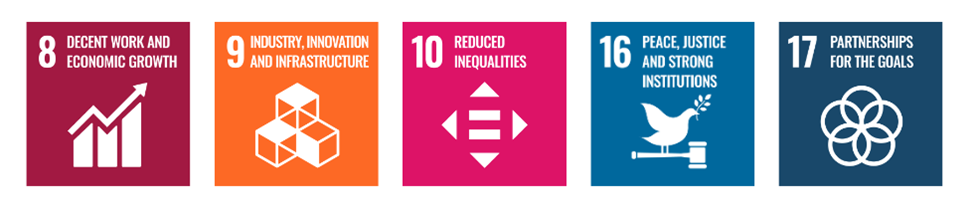
SDG 8: Decent Work and Economic Growth
SDG 8: Decent Work and Economic Growth
The portal simplifies access to customs information and services for businesses and economic operators. More efficient customs interactions reduce administrative effort and support smoother participation in domestic and international trade.
SDG 9: Industry, Innovation and Infrastructure
The project replaces fragmented and outdated digital channels with a modern, scalable, and interoperable service environment. It strengthens the digital infrastructure supporting customs administration and cross-border economic activity.
SDG 10: Reduced Inequalities
Information and services are presented through a bilingual, device-responsive portal designed with accessibility needs in mind. This helps reduce barriers for users with different language, technology, and accessibility requirements.
SDG 16: Peace, Justice and Strong Institutions
Centralized information, transparent service descriptions, system-status updates, and more consistent digital processes support a more effective, accountable, and user-oriented public institution. Automation and standardized access also help improve the consistency of administrative service delivery.
SDG 17: Partnerships for the Goals
The transformation was enabled through cooperation between Lithuanian Customs, NRD Companies, the Lithuanian state, and the European Union. It demonstrates how institutional, technological, and financial partnerships can support sustainable public-sector modernization.